 Attestorian
Stop out-of-policy AI actions before they run.
Logging a harmful action after it happens is not control. Guard sits on the path between your agents and their tools, and decides whether each action may proceed.
Agents follow instructions, including the wrong ones.
An agent reading an invoice, email, or web page can be manipulated by text hidden inside it. An agent with access to payments, records, or messaging can act faster than any human can intervene.
Prompt injection
Hidden instructions in untrusted content.
Over-reach
Actions beyond the agent's intended authority.
Tool drift
Tool definitions that change after approval.
Missing oversight
High-impact actions with no human check.
Four checks on every tool call.
Is the tool allowed?
Allow-lists per agent, user, and tenant define which tools an agent may call at all.
Are parameters in policy?
Limits on amounts, data scopes, recipients, rates, and time windows are enforced before execution.
Is the tool unchanged?
Tool definitions are fingerprinted at approval, so an unexpected change is caught.
Is the input trustworthy?
Instructions that originate in untrusted content, such as uploaded documents, are detected and blocked.
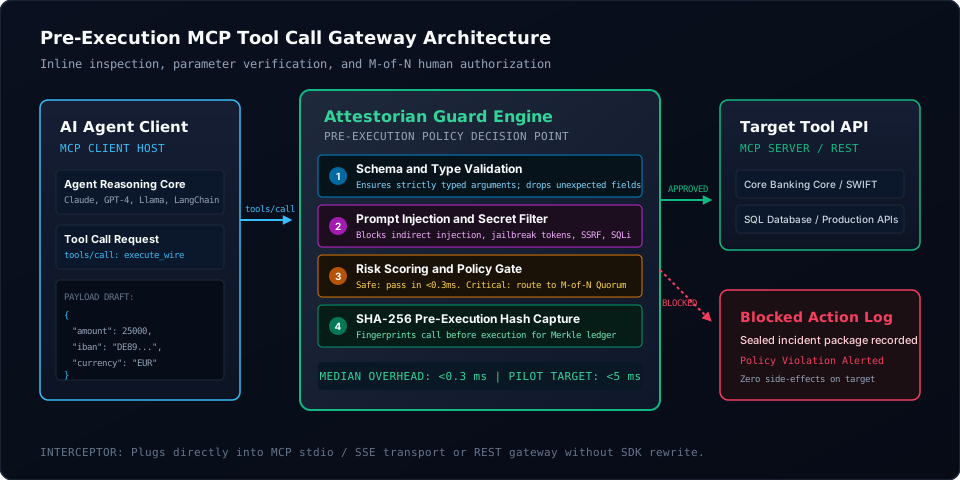
Four-eyes approval, enforced by the system.
For high-impact actions, Guard pauses execution until the required number of authorized people approve. Approver identities and timestamps are bound into the evidence, so the record shows who authorized what.
- Configurable M-of-N approval rules per action type and threshold
- Approvals recorded as part of the sealed evidence
- Blocked and approved decisions are both evidence
Control you can prove.
- Pre-execution policy enforcement on agent tool calls
- Prompt injection detection on untrusted inputs
- Tool definition integrity checks
- M-of-N human approval workflows
- Counterfactual replay to test new policies on recorded sessions
- Lightweight: local benchmark median under 0.3 ms added per tool call (pilot acceptance target: 5 ms or less)
Honest limits. Guard enforces the policies you define on the paths it sits on. It does not judge whether a policy is wise, and detection of manipulated inputs reduces risk rather than eliminating it. Performance figures come from local benchmarks and are measured in your environment during a pilot.
Next
Once an action is allowed, Seal turns it into tamper-evident evidence.
Frequently asked questions
What four checks does Attestorian Guard perform on every AI tool call?
Attestorian Guard executes four deterministic pre-execution checks on every tool call: (1) tool allow-list verification per agent, user, and tenant, (2) parameter policy validation on monetary limits, scopes, and recipients, (3) cryptographic tool definition fingerprint verification against tool drift, and (4) untrusted input provenance checks against prompt injection.
How much latency does Attestorian Guard add to AI agent tool calls?
In local benchmarks, the Attestorian Guard inline gateway adds a median latency of under 0.3 milliseconds per tool call, with an enterprise pilot acceptance target of 5 milliseconds or less, ensuring real-time policy enforcement without degrading agent responsiveness.
Enforce policy on your AI agent tool calls.
Test pre-execution policy enforcement and M-of-N human approval on your AI workflows. The USD 10,000 pilot fee is credited in full toward your annual license.
Last updated: