 Attestorian
One layer between your AI agents and everything they touch.
Attestorian sits beside your agents and orchestration layer. It decides what an agent is allowed to do, records what it actually did, and turns that record into evidence anyone can verify.
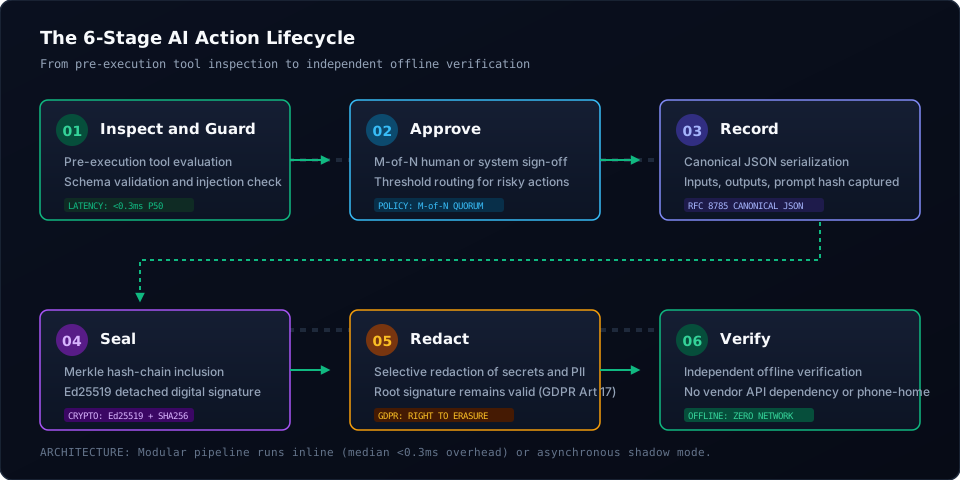
The life of every AI action.
Inspect and guard
Policy, tool integrity, and injection checks before execution.
Approve
Four-eyes or M-of-N approval for high-impact actions.
Record
Inputs, checks, tool calls, results, and outputs.
Seal
Chained, signed, portable evidence packages.
Redact
Hide fields while the seal remains verifiable.
Verify
Free offline verifiers for anyone.
Decide before the agent acts.
Every tool call passes through a policy gate. Out-of-policy actions are blocked, and the block itself becomes evidence.
- Allow-lists of tools per agent, user, and tenant
- Parameter limits such as amounts, scopes, recipients, and time windows
- Detection of tool definitions that changed since approval
- Detection of hidden instructions inside documents and messages
- Human co-approval with approver identity bound into the record
Evidence by default, in a few lines of code.
Recorders wrap existing tool calls. Each step is chained to the previous one and signed, producing a compact evidence package that travels anywhere.
- Python and TypeScript SDKs, an inline tool gateway, and an OpenTelemetry bridge
- Any change, removal, reordering, or insertion fails verification
- Signing keys held in your own KMS or HSM
- Industry-standard, publicly reviewed cryptography in the production core
# Record an agent action and export sealed evidence
from attestorian import AttestorianAgent, verify_package

agent = AttestorianAgent("session-7f3a", signing_seed)

agent.record(
    "create_payment",
    {"amount": "250000.00", "currency": "USD"},
    {"status": "settled"},
)

package = agent.export_package()
report = verify_package(
    package,
    pinned_public_key_hex=public_key,
)
assert report.valid and report.code == 0   # fails on any alteration
Python SDK quick start. In production, signing keys are loaded from your key management service rather than held in application code.
Share proof, not personal data.
Hide names, identifiers, and account numbers from an external copy. The reviewer can still confirm the rest of the record is exactly as sealed, using a free verifier that runs offline.
Selective redaction
Field-level hiding with the seal intact.
Offline verifiers
Command line, embeddable, and browser.
No lock-in
Evidence stays checkable for years.
Anyone can check
No account or connection needed.
Everything evidence teams ask for next.
Counterfactual replay
Re-run a recorded session against a stricter policy and see exactly which step would have been blocked.
Compliance dossier compiler
Audit binders mapped to frameworks. Every statement must link to sealed evidence, or the dossier will not compile.
Model and supply-chain lineage
Know which model, prompt, tool, and software versions produced each action.
Drift and poisoning signals
Flags behavioural drift and suspicious changes in AI inputs and outputs over time.
Multi-tenant control plane
Tenant-isolated evidence storage with database row-level security.
Retention and sharing controls
Configurable retention, identity, and sharing rules per tenant and jurisdiction.
Three ways to run Attestorian.
In every option, data stays where it already lives. Verification never requires sending data to us.
Shadow mode
Reads existing traces and seals them without touching live paths. Ideal for pilots and first rollouts.
Inline guard mode
Sits on agent tool calls and enforces policies and approvals before actions execute.
Sovereign or private
Runs entirely inside your private cloud or data center with local key custody.
Frequently asked questions
What are the three deployment modes for the Attestorian platform?
Attestorian supports three deployment modes: Shadow mode (reads existing OpenTelemetry or agent traces and seals them without touching live paths), Inline Guard mode (intercepts live tool calls to enforce policies and M-of-N approvals before execution), and Sovereign mode (runs air-gapped on-premise with customer HSM custody).
How does counterfactual replay work in Attestorian?
Counterfactual replay allows security and risk teams to re-run previously recorded and sealed AI agent sessions against a stricter policy definition offline, identifying exactly which tool calls, parameters, or untrusted inputs would have been paused or blocked prior to rolling the policy into production.
Evaluate the platform in your architecture.
Book a live technical walk-through on an offline machine, or start a 30-day pilot on a mission-critical AI tool call flow. The USD 10,000 fee is credited in full.
Last updated: